acid-base equilibrium worksheet with answers pdf
Acid-Base Equilibrium Worksheet with Answers: A Comprehensive Plan
Comprehensive acid-base equilibrium practice, including Ka calculations, pKa relationships, and buffer solutions, is vital for mastering chemistry concepts;
PDF resources offer practice problems focusing on equilibrium concentrations, titration curves, and acid/base strength determination, enhancing understanding.
These worksheets aid in solving for unknown concentrations and applying the Henderson-Hasselbalch equation, solidifying core principles.

Acid-base equilibria represent a cornerstone of chemistry, describing the extent to which acids donate protons and bases accept them in reversible reactions. Understanding these equilibria is crucial for predicting reaction direction and quantifying species concentrations. A solid grasp of these principles is often assessed through acid-base equilibrium worksheets, frequently available as PDF resources.
These worksheets typically begin with foundational concepts, such as defining acids and bases using the Brønsted-Lowry theory, and then progress to more complex calculations involving the acid dissociation constant (Ka) and its relationship to pH. Mastering these concepts requires practice, and PDF worksheets provide a convenient and accessible method for students to reinforce their learning.
The ability to solve problems related to equilibrium concentrations, buffer solutions, and titration curves demonstrates a comprehensive understanding of acid-base chemistry. These worksheets often include a variety of problem types, ranging from simple Ka calculations to more challenging scenarios involving polyprotic acids and buffer capacity. Utilizing practice problems and solutions is key to success.
Defining Acids and Bases: Brønsted-Lowry Theory
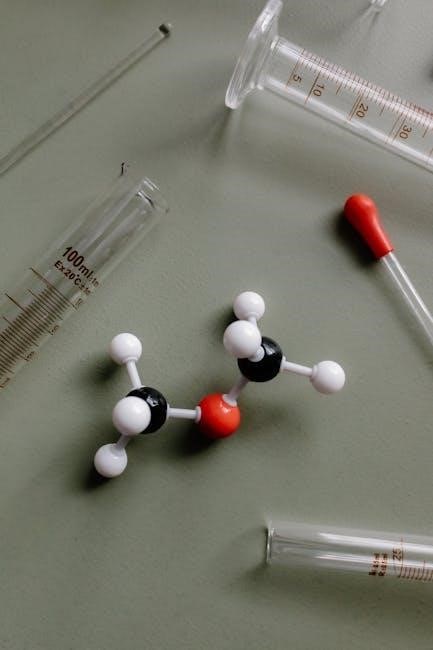
The Brønsted-Lowry theory defines acids as proton (H+) donors and bases as proton acceptors – a crucial concept explored in acid-base equilibrium worksheets. This contrasts with earlier definitions, offering a broader scope for understanding acid-base interactions. PDF resources dedicated to these worksheets often begin by solidifying this foundational definition.
Understanding this theory is paramount for predicting the outcome of acid-base reactions. A key component of these worksheets involves identifying conjugate acid-base pairs formed during proton transfer. Students practice recognizing which species acts as the acid and which acts as the base in a given reaction, a skill reinforced through numerous practice problems.
These worksheets frequently present reactions where students must determine the resulting species after proton transfer, and then assess the relative strengths of the acids and bases involved. The availability of solutions in PDF format allows for self-assessment and targeted review. Mastering this theory is essential for tackling more complex equilibrium calculations.
Understanding Acid Dissociation Constant (Ka)
The acid dissociation constant (Ka) quantifies the strength of an acid in solution, representing the extent of its dissociation into ions. Acid-base equilibrium worksheets heavily emphasize Ka calculations, as it’s central to predicting acid behavior. PDF resources provide structured practice in determining Ka values from equilibrium concentrations.
These worksheets typically present equilibrium reactions of weak acids in water, requiring students to set up ICE tables (Initial, Change, Equilibrium) to determine the concentrations of all species at equilibrium. From these concentrations, the Ka value is calculated using the expression: Ka = [H+][A–]/[HA].
Many practice problems involve scenarios where initial concentrations are given, and students must solve for Ka. Conversely, some worksheets provide Ka and ask for equilibrium concentrations. The solutions included in the PDF guides demonstrate step-by-step approaches, aiding comprehension. A smaller Ka indicates a weaker acid, a concept consistently reinforced.
Calculating Ka from pH and Concentration
Acid-base equilibrium worksheets frequently task students with determining the Ka of a weak acid given its initial concentration and pH. PDF resources offer extensive practice in this crucial skill, bridging the gap between experimental data and theoretical understanding. The process begins by calculating the hydrogen ion concentration [H+] from the provided pH value using the formula [H+] = 10-pH.
Next, an ICE table is constructed to represent the equilibrium concentrations of the weak acid (HA) and its conjugate base (A–). Knowing [H+] at equilibrium allows for the determination of [A–], and subsequently, the remaining concentration of HA.
Finally, the Ka is calculated using the expression: Ka = [H+][A–]/[HA]. Practice problems often involve scenarios requiring careful attention to significant figures and unit consistency. Solutions within the PDF guides provide detailed explanations, ensuring students grasp the methodology.
Dilution and its Impact on Ka Calculations
Acid-base equilibrium worksheets, often available as PDF downloads, emphasize that the Ka value itself remains constant upon dilution. However, dilution significantly alters the equilibrium concentrations, requiring careful recalculation. The initial concentration changes according to the dilution equation: M1V1 = M2V2. This new initial concentration is crucial for setting up an updated ICE table.
While Ka doesn’t change, the position of equilibrium shifts to relieve stress, as dictated by Le Chatelier’s principle. Dilution favors the side with more moles, in this case, the dissociation of the weak acid. Practice problems frequently present scenarios where students must first calculate the diluted concentration, then re-establish the equilibrium using the constant Ka value.
Solutions in these PDF resources demonstrate how to correctly apply the dilution factor and recalculate [H+] and pH, reinforcing the understanding that Ka is an intrinsic property, not affected by volume changes.
The Concept of pKa and its Relationship to Acid Strength
Acid-base equilibrium worksheets, frequently found as PDF documents, introduce pKa as the negative logarithm of the acid dissociation constant (Ka): pKa = -log10Ka. This transformation provides a more convenient scale for comparing acid strengths, as Ka values are often very small. A lower pKa value indicates a stronger acid, and vice versa.
Practice problems within these resources often require students to convert between Ka and pKa, and to rank acids based on their pKa values. For example, comparing lactic acid (pKa 3.88), oxalic acid (pKa 1.23), and malic acid (pKa 3.40) demonstrates that oxalic acid is the strongest.
Solutions emphasize the inverse relationship: a larger Ka corresponds to a smaller pKa; Understanding this concept is fundamental for predicting the relative acidity of different compounds and interpreting acid-base equilibrium scenarios. These worksheets solidify this crucial connection.
Conjugate Acid-Base Pairs
Acid-base equilibrium worksheets, often available as PDFs, heavily emphasize the concept of conjugate acid-base pairs. These pairs differ by only a proton (H+). An acid donates a proton to become its conjugate base, while a base accepts a proton to become its conjugate acid.
Practice problems frequently involve identifying conjugate pairs in chemical reactions. For instance, in the reaction HCN + NH3 ⇌ CN– + NH4+, HCN and CN– form a conjugate pair, as do NH3 and NH4+.
Worksheet solutions demonstrate how to systematically determine these pairs. Understanding this relationship is crucial for predicting the direction of equilibrium and calculating equilibrium concentrations. These exercises reinforce the Brønsted-Lowry definition of acids and bases. Mastering this concept is essential for tackling more complex acid-base chemistry problems.
Determining the Strength of Conjugate Bases
Acid-base equilibrium worksheets, often in PDF format, dedicate sections to evaluating conjugate base strength. The strength of a conjugate base is inversely proportional to the strength of its parent acid – a strong acid yields a weak conjugate base, and vice versa.

Practice problems frequently present a series of acids with known pKa values (like lactic, oxalic, and malic acid examples). Students must then rank the corresponding conjugate bases in order of increasing or decreasing strength. This requires understanding that a lower pKa indicates a stronger acid and, consequently, a weaker conjugate base.
Worksheet solutions provide step-by-step guidance on this process, emphasizing the relationship between Ka, pKa, and base strength. These exercises build a solid foundation for predicting reaction outcomes and understanding acid-base equilibria. Successfully completing these tasks demonstrates a grasp of fundamental chemical principles.
Acid-Base Equilibria in Polyprotic Acids
Acid-base equilibrium worksheets, commonly available as PDF documents, extend beyond monoprotic acids to encompass polyprotic acids – those capable of donating multiple protons. These worksheets focus on the concept of stepwise dissociation, where each proton donation has its own associated Ka value (Ka1, Ka2, etc.).
Practice problems challenge students to calculate the pH at various points during the titration of a polyprotic acid, considering each dissociation step separately. Understanding that Ka1 is always greater than Ka2 (and so on) is crucial, as it dictates the extent of each ionization.
Worksheet solutions demonstrate how to set up and solve these complex equilibrium problems, often involving approximations due to the significant differences in Ka values. Mastering this topic requires careful attention to detail and a strong grasp of equilibrium principles, solidifying understanding of acid behavior.
Stepwise Dissociation and Ka Values for Polyprotic Acids
Acid-base equilibrium worksheets, often in PDF format, heavily emphasize stepwise dissociation for polyprotic acids. These acids, like oxalic acid or phosphoric acid, don’t donate all protons simultaneously. Each dissociation step has a unique Ka value, reflecting its equilibrium constant.
Practice problems within these resources require students to write out each dissociation reaction (e.g., HA → H+ + A–, then A– → H+ + A2-) and determine the Ka expression for each. A key concept is that successive Ka values decrease (Ka1 > Ka2 > Ka3), indicating diminishing acidity with each proton removal.
Worksheet solutions guide students through calculating hydrogen ion concentrations and pH at each stage, often employing approximations when Ka values differ significantly. These exercises reinforce the understanding that the complete picture of a polyprotic acid’s behavior requires considering each dissociation step individually.
Buffers: Composition and Function
Acid-base equilibrium worksheets, frequently available as PDF downloads, dedicate significant attention to buffers. These solutions resist pH changes upon addition of acid or base, crucial in biological and chemical systems. A typical worksheet will define a buffer as a mixture of a weak acid and its conjugate base, or a weak base and its conjugate acid.
Practice problems focus on identifying buffer components and explaining how they neutralize added H+ or OH– ions. Students learn that the weak acid neutralizes base, while the conjugate base neutralizes acid, minimizing pH shifts. Many exercises involve calculating the pH of buffer solutions using the Henderson-Hasselbalch equation.
Worksheet solutions often include scenarios demonstrating buffer action, like adding small amounts of strong acid or base to a buffer solution and observing the limited pH change. Understanding buffer composition and function is essential, and these resources provide ample practice.
Henderson-Hasselbalch Equation: Calculation of Buffer pH
Acid-base equilibrium worksheets, often in PDF format, heavily emphasize the Henderson-Hasselbalch equation: pH = pKa + log([A–]/[HA]). This equation provides a straightforward method for calculating the pH of a buffer solution, given the pKa of the weak acid and the concentrations of its conjugate base ([A–]) and the weak acid ([HA]).
Practice problems typically involve determining the pH of buffers with varying concentrations of acid and base. Worksheet solutions demonstrate how to correctly apply the equation, emphasizing the logarithmic relationship between the concentration ratio and pH change. Students practice calculating pH when given concentrations, and conversely, calculating concentrations when given pH and pKa.
Many worksheets include exercises requiring students to select appropriate buffer systems for specific pH ranges, utilizing known pKa values. Mastering this equation is crucial, and these resources provide ample opportunity for practice and understanding.
Buffer Capacity and its Limitations
Acid-base equilibrium worksheets, frequently available as PDF downloads, explore buffer capacity – the amount of acid or base a buffer can neutralize before significant pH changes occur. This capacity is maximized when the concentrations of the weak acid and its conjugate base are equal, providing optimal resistance to pH shifts.
Practice problems often involve calculating the buffer capacity given specific concentrations, or determining the pH change after adding a certain amount of strong acid or base. Worksheet solutions illustrate how exceeding the buffer’s capacity leads to drastic pH alterations, rendering the buffer ineffective.
Limitations are also addressed; worksheets demonstrate that buffers have a limited operating range, typically ±1 pH unit from the pKa. Furthermore, dilution reduces the concentrations of both acid and base, decreasing buffer capacity. Understanding these limitations is vital for practical applications.
Acid-Base Titrations: Principles and Curves
Acid-base titration worksheets, commonly found as PDF resources, focus on the principles of neutralizing an acid with a base (or vice versa) and graphically representing this process with titration curves. These curves plot pH against the volume of titrant added, revealing key points like the equivalence point.
Practice problems involve calculating pH at various points during the titration, including before the equivalence point, at the equivalence point, and after the equivalence point. Worksheet solutions demonstrate how to select the appropriate indicator based on the pH range of the equivalence point.
Understanding the shape of the titration curve – steep changes near the equivalence point for strong acid-strong base titrations, and more gradual changes for weak acid/base systems – is crucial. PDF examples often include detailed curve analysis and calculations of Ka from titration data.
Equivalence Point and Endpoint Determination
Acid-base titration worksheets, often available as PDF documents, emphasize the distinction between the equivalence point and the endpoint. The equivalence point is the theoretical point where moles of acid equal moles of base, calculated stoichiometrically. Practice problems focus on determining this point using titration data.
The endpoint, however, is the experimentally observed point, signaled by an indicator change. Worksheet solutions demonstrate how to select an appropriate indicator whose color change closely matches the equivalence point’s pH. Calculations involve determining the volume of titrant needed to reach the equivalence point.
PDF resources often include scenarios where the equivalence point isn’t easily visible, requiring calculations based on the titration curve. Understanding the relationship between Ka, Kb, and the pH at the equivalence point is key. Practice includes identifying errors in endpoint determination.
Titration Calculations: Determining Unknown Concentrations
Acid-base titration worksheets, frequently in PDF format, provide extensive practice in calculating unknown concentrations. These calculations rely on the stoichiometry of the neutralization reaction and the volume of titrant required to reach the equivalence point. Practice problems guide students through setting up chemical equations and determining mole ratios.
PDF resources emphasize using the formula: MacidVacid = MbaseVbase, where M represents molarity and V represents volume. Worksheet solutions demonstrate how to handle dilutions and account for limiting reactants. Students learn to calculate the concentration of an unknown acid or base.
Advanced practice involves polyprotic acids and weak acid/base titrations, requiring consideration of Ka or Kb values. Titration curves are often used to visually confirm calculations and understand the titration process. Mastering these calculations is crucial for quantitative analysis.
Real-World Applications of Acid-Base Equilibria

Acid-base equilibria are fundamental to numerous real-world processes, and worksheets (often available as PDF downloads) illustrate these connections. Understanding pH regulation in biological systems, like blood buffering, is a key application; Practice problems demonstrate how buffers resist pH changes, vital for maintaining cellular function.
Environmental science relies heavily on acid-base chemistry, including acid rain analysis and water quality assessment. PDF resources often include scenarios involving industrial effluent treatment and pollution control. Agricultural applications, such as soil pH optimization for crop growth, are also explored.
Furthermore, many industrial processes, like chemical manufacturing and food production, depend on precise pH control. Worksheet solutions showcase how these principles are applied in practical settings. Studying these applications reinforces the importance of mastering acid-base equilibrium concepts.
Practice Problems and Solutions (PDF Resources)
Acid-base equilibrium worksheets, readily available as PDF resources, are crucial for solidifying understanding. These materials typically include a diverse range of problems, from calculating Ka and pKa values to determining pH in buffer solutions and during titrations.
Many PDFs offer step-by-step solutions, enabling students to check their work and identify areas needing improvement. Practice problems often involve setting up equilibrium expressions, ICE tables, and applying the Henderson-Hasselbalch equation; Some resources focus on polyprotic acids and their stepwise dissociation.
Online platforms and educational websites frequently host these PDFs, providing convenient access to a wealth of practice material. Utilizing these resources allows for self-paced learning and reinforces the concepts of acid-base equilibria. Mastering these problems builds confidence and prepares students for exams.